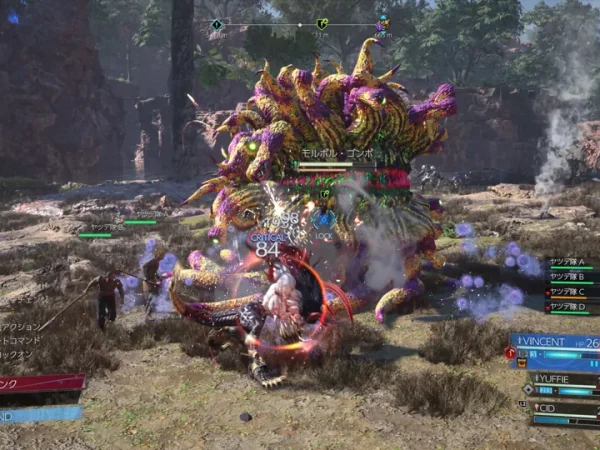
In an interview with IGN Japan during the 2026 Tokyo Game Show, Final Fantasy VII Revelation director Naoki Hamaguchi revealed that the game would include an option for automatic character leveling, allowing players to experience the story without the need for grinding—a design choice that has sparked significant debate among the broader player base. Like other entries in the series, Final Fantasy VII Revelation places a strong emphasis on narrative. Hamaguchi explained at TGS 2026 that the game would offer features for players who simply want to breeze through difficult battles and reach key story milestones without hassle.
More on this topic:
Final Fantasy VII Revelation requires 200GB of storage space
Final Fantasy VII Revelation requires 200GB of storage space
Speaking to us, he noted that he had received feedback from players who struggled to progress through the main story in previous titles due to insufficient character levels, yet had no desire to grind through the game’s extensive side content. He explained: “Naturally, since we’ve prepared so much side content, there’s a possibility that a player’s level might fall short of the main story’s requirements. Some players told us, ‘You say side content isn’t mandatory, but if I skip it and don’t strengthen my characters, I’ll struggle when trying to advance the main plot.’ So, for those who really just want to experience the main story, we’ve added an option: if you reach a point in the main story where your level is below the recommendation, the game will ask, ‘Would you like to automatically boost your level to the recommended one?'”
This statement has ignited heated debate within the gaming community. A common argument among detractors is that such a feature makes the game feel like it is “coddling” the player; furthermore, it seems to imply that younger players today are increasingly unaccustomed to facing genuine challenges in games.
Veteran game artist TheCartelDel articulated one of the most widely shared arguments against this feature. He wrote on X: “We really need to have a serious discussion about this: in the past, games offered a unique way to teach children and teenagers about patience, delayed gratification, and the effort required to achieve a goal. Now, however, we are designing away the very need for persistence. You end up not learning how to overcome any obstacles.”
Given that massive open worlds can easily cause “choice fatigue” for players who prefer linear experiences, Naoki Hamaguchi noted that the development team is striving to strike a balance: providing enough guidance for those who might get lost during exploration while also accommodating players who enjoy exploring freely on their own. He also mentioned receiving feedback suggesting that the game’s guidance features were somewhat excessive. Hamaguchi stated, “Some players want to explore freely, while others don’t want to get lost. So, I believe modern open-world games do require robust guidance systems. On the other hand, players who enjoy discovering content for themselves have said that this guidance can be too intrusive or even a hindrance. We are currently considering options, such as allowing players to toggle these guidance features on or off.”
In any case, it is clear that Hamaguchi is well aware of player concerns regarding games “doing too much” for them. It is also worth noting that many modern AAA titles offer difficulty modes specifically designed for experiencing the story, so the auto-leveling feature Hamaguchi mentioned is not entirely new.